
Private label starts with a platform
A private-label programme commonly uses an established cabinet with agreed branding, colour, accessories and market configuration. It can shorten development work when the base product already fits the placement and pack-out.
OEM can involve deeper changes
Changes to dimensions, refrigeration layout, doors, structure, electronics or moulded parts can require engineering review, tooling, samples and additional validation. The boundary varies by supplier, so define the actual change rather than relying on the label.
Compare programme risk
List each change's tooling, sampling, component, document and service costs alongside the business objective. Confirm quantity and schedule effects in the quotation, then decide which changes are necessary for the first launch.
Create a staged roadmap
One staged route is to evaluate a branded standard cabinet in a pilot before deciding which deeper changes support a larger rollout. Record which features belong in the first launch, what the pilot must establish and which decisions can wait for the next revision.
Match the project path to the requested change
If the existing cabinet already fits the package, placement and destination, begin with the current platform and define the logo, colour, lightbox, glass treatment or packaging changes. If the needed dimensions, door motion, cooling layout or electrical design differ, treat the project as an engineering change and ask which drawings, tooling, tests and market files need revision.
Use the same product pack and site conditions to compare both routes. A visual concept may show the intended retail appearance, but it does not prove the air path, temperature performance, certification scope or production feasibility of a changed cabinet.
Build one decision record for the RFQ
Record the base model or proposed platform, destination and power supply, product pack, required temperature, cabinet footprint, door or lid access, brand surfaces, quantity by phase, target date and documents needed. Mark each requested feature as existing, artwork-only, component option or engineering change so quotations can be compared on the same scope.
Before sample approval, assign separate owners to the visual artwork and technical configuration. Keep the approved drawing revision, appearance proof, acceptance checks and unresolved exceptions together so the production decision does not depend on an attractive rendering alone.
Name the change and the required review
Project labels do not define the approval work. A header graphic, transparent glass treatment, glass-heating change and new door structure raise different questions; ask which files and samples control each proposal.
| Proposed change | Inputs to review | Confirmation before release |
|---|---|---|
| Lightbox artwork | Face template, material, print and lighting | Approved visual proof and included panel scope |
| Transparent glass graphic | Door construction, visibility and treatment | Material sample and cleaning requirements |
| Glass heating | Door assembly, power and wiring | Engineering, performance and file applicability |
| Door structure | Opening, hinges or track, seal and load | Mechanical drawing, test plan and document review |
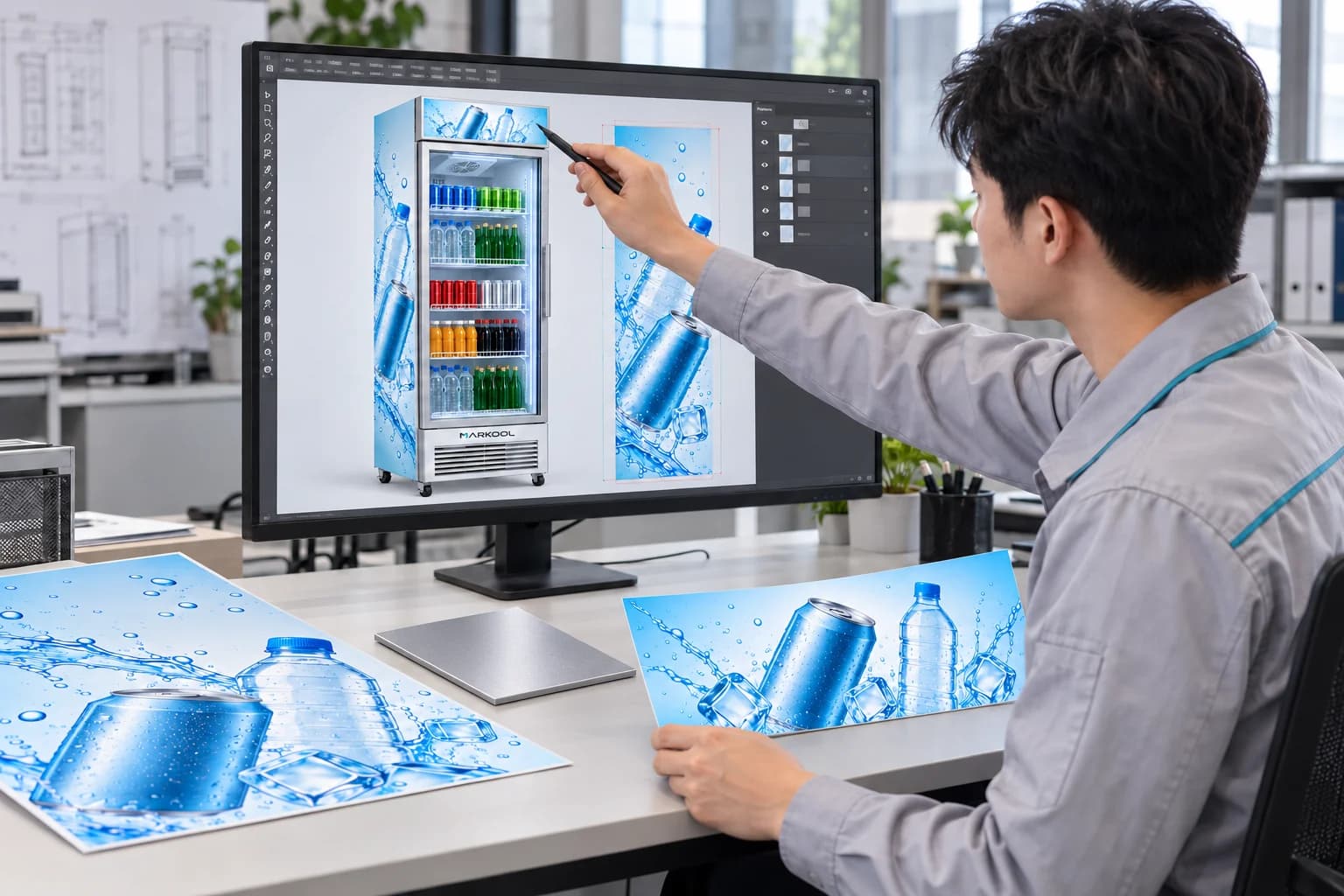
Separate an artwork revision from a hardware change
Compare the approved graphic layout with the printed header, side panels and shelf strips. Identify any change to the cabinet or attachment separately so that a visual approval does not release an unreviewed component, material or installation detail.
- Artwork and print-template revision
- Physical material and colour sample
- Separate list of technical changes
Apply the checklist
Define your OEM or private-label path.
Describe the product pack, cabinet format, destination, expected quantity and changes from the selected reference platform. MARKOOL can identify what belongs in artwork review and what needs engineering validation.
Request a project concept ↗