
1. Begin with the operating context
A commercial display cooler should be selected around what it stores, where it operates and how shoppers interact with it. Record the destination country, voltage, frequency, ambient temperature, ventilation constraints and whether the cabinet is freestanding, built in or exposed to direct sun.
Temperature range alone is not enough. Door openings, product loading pattern and airflow around the condenser all affect real-world performance.
2. Calculate usable pack-out
Gross litres do not tell procurement teams how many cans, bottles or tubs will fit. Share the actual package dimensions, target facings and replenishment method. A pack-out drawing can then confirm shelf spacing, door access and usable capacity before a sample is built.
3. Match cabinet format to the purchase moment
Countertop coolers create visibility close to checkout. Slim uprights work in narrow footprints. Double-door merchandisers support high-volume retail, while open-air cabinets favour fast access. Choose the format based on the retail task rather than the largest stated capacity.
4. Test the shortlist against real placement scenarios
At a checkout counter, start with the actual can or bottle set, available counter space, permitted weight, electrical outlet and the number of visible facings. A compact glass-door model and a taller countertop cabinet can solve different display tasks even when both are called mini fridges.
For a back bar, compare a hinged-door and a sliding-door access pattern against the staff aisle, bottle height, ventilation path and replenishment movement. A low cabinet or worktop does not automatically make a refrigerator suitable for enclosed installation.
For grab-and-go retail, compare open-front access with glass-door temperature control under the intended ambient conditions and shopper traffic. Record test conditions and product loading instead of assuming an open cabinet and a closed cabinet have the same cooling or energy behaviour.
A solid-door kitchen reach-in is a different buying task from a shopper-facing display cooler. If food holding rather than merchandising is the objective, describe the food, temperature and kitchen workflow before choosing a cabinet.
5. Confirm the destination-market package
Voltage, plug, refrigerant, labeling and certification scope must be confirmed for the exact model and market. Ask for model-specific evidence instead of relying on a general list of logos.
6. Plan branding and service access together
Cabinet-body graphics, canopy treatment, glass-door artwork and shelf messaging can affect cleaning, airflow, service panels and material choices. Select only the areas supported by the chosen cabinet and approve the artwork on its current drawing.
7. Compare the complete rollout cost
Evaluate samples, tooling, graphics, inspection, spare parts, protective packaging and freight—not only the cabinet unit price. A slightly different platform may reduce container space, damage risk or field-service cost across the full program.
Keep the shortlist on one comparison sheet
Use the same packages, target condition and placement drawing for each shortlisted cabinet. Record the closed dimensions separately from door movement and ventilation clearances. An unavailable value should remain an open question rather than being copied from a nearby model.
| Decision | Buyer input | Request for each model |
|---|---|---|
| Counter presentation | Counter area, overhead space, pack samples | Drawing, weight, shelf plan and door clearance |
| Double-door display | Assortment by bay, aisle and delivery route | Open-door drawing and own pack-out |
| Back-bar service | Bar opening, staff aisle, bottle mix | Access pattern and installation confirmation |
| Open-front display | Ambient conditions, airflow, restocking | Operating conditions, shelf and maintenance plan |
Plug-in or remote: compare the installation scope
An integral or plug-in cabinet includes its refrigeration unit; a remote display connects to a separately located refrigeration system. Compare the whole installation rather than the cabinet price alone. The options below are a planning comparison, not a statement that both are available for every listed model.
For either approach, identify the heat-rejection arrangement, electrical supply, condensate handling and maintenance access. For a remote proposal, ask the refrigeration contractor to confirm the system match, pipe route and commissioning scope. Do not assume a generic maximum pipe length from another project.
| Decision | Integral / plug-in proposal | Remote proposal |
|---|---|---|
| Included equipment | Identify the cabinet and onboard refrigeration package | Identify cabinet, external plant, controls and exclusions |
| Site work | Confirm power, clearance and condensate arrangements | Confirm plant location, line route, power and drainage |
| Heat and noise | Request data relevant to the in-store installation | Review cabinet and external-plant conditions separately |
| Handover | Installation instructions and service access | System commissioning record and installer responsibility |
| Comparable cost | Cabinet, delivery, installation and operation | Add external plant, site works and ongoing service |
Choose kitchen refrigeration by the work sequence
A kitchen buying brief starts with the staff task: reserve storage, preparation, ingredient access or customer display. The European Commission distinguishes professional refrigerated storage from direct-sales refrigeration. That distinction helps avoid treating a shopper-facing display cooler as an interchangeable kitchen storage cabinet.
Bring the actual containers, replenishment routine and available work area into the comparison. Cabinet format alone does not establish suitability for a food, temperature requirement or handling process.
| Workflow | Format to discuss | Questions to resolve |
|---|---|---|
| Reserve storage | Upright reach-in | Container fit, door access, shelf loads and holding requirement |
| Preparation at a work surface | Refrigerated workbench | Worktop use/load, staff access, ventilation and cleaning |
| Ingredients during assembly | Prep table | Pan dimensions/depth, lid use, replenishment and holding evidence |
| Customer selection | Display cabinet | Visibility, access pattern, loading and placement conditions |
Technical references
These sources explain the topic; they are not certification or test evidence for a MARKOOL model.
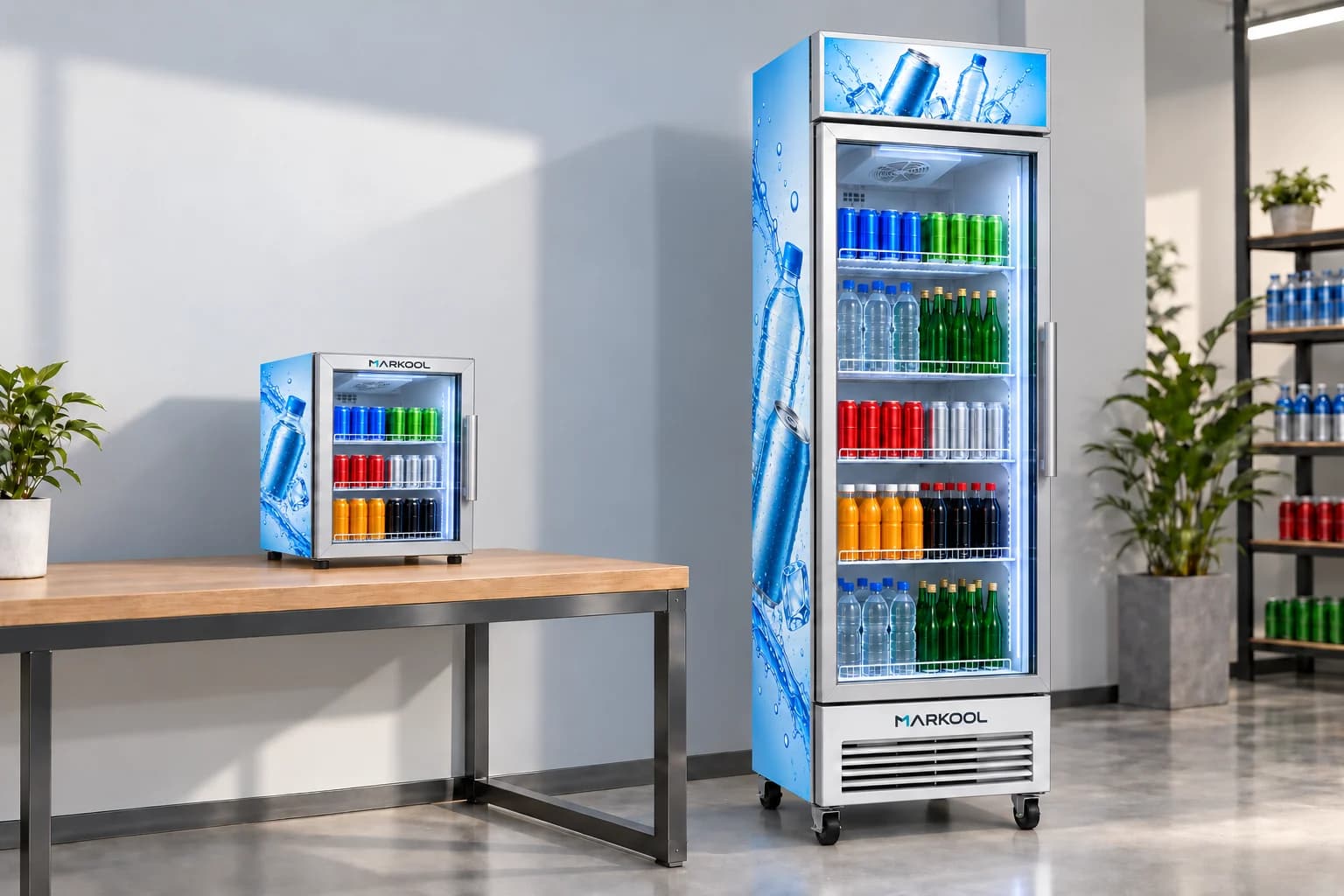
Compare the selling position before the cabinet size
A countertop cooler places a focused drinks selection beside the transaction. An upright format supports a different assortment and customer reach. Compare available space, pack sizes, door access and replenishment before choosing the model.
- Counter or floor placement dimensions
- Drinks assortment and required facings
- Customer access and restocking route
Apply the checklist
Turn the questions into a project brief.
Share the destination, product pack, quantity and intended placement. We’ll identify the reference platform and the information still needed.
Discuss a refrigeration project ↗